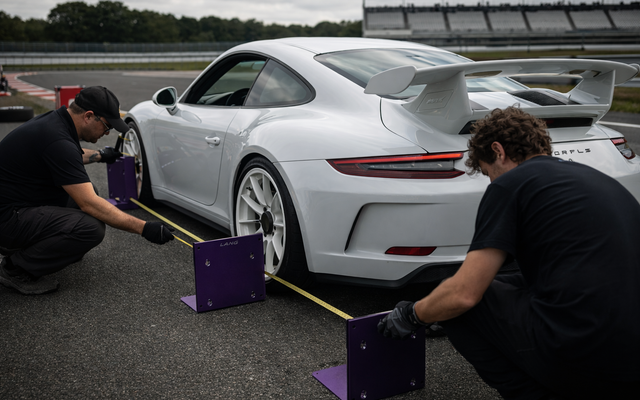
Within the demanding arena of modern professional sliding, victory is far more than purely a product of brute engine power or pilot courage. Rather, it has evolved into a intricate discipline that demands a painstaking fusion of selecting a time-tested car, outfitting it with the most precise drift-spec parts, and, most importantly, understanding its dynamic characteristics on the circuit through sophisticated vehicle dynamics analysis tools. This comprehensive guide functions as your master plan starting from the initial idea of a competition vehicle right through to the final engineering-refined refinements that elevate a powerful vehicle into a repeatable podium finisher. We will thoroughly explore the art and science of car suspension tuning, showing how a state-of-the-art suspension tuning tool like precise measurement hardware eradicates approximation and provides exceptional clarity into your car's true performance.
The foundation of any great competitive sliding vehicle is, indisputably, the base vehicle itself. A select group of platforms have earned renowned status within the international oversteer scene due to their inherent handling characteristics, robust build quality, and the enormous range of specialist support available. Selecting the correct starting point is the first and most significant selection a builder will make. As an example, the the E36 generation BMW is commonly accepted as perhaps the the best overall cars for drifting of all time. Its almost ideal evenly distributed mass, alongside a rear-wheel-drive configuration and robust six-cylinder engines, creates a platform that is at once easy to handle for newcomers and extremely effective in the hands of a professional driver. The successor of this concept, the E46 model BMW, improves on these attributes with a increasingly sophisticated structure, broader wheel track for improved stability, and even increased steering angle straight from the OEM. A distinct formidable option in the top-level arena is the C6 generation Corvette.
This American track weapon introduces a unique set of benefits to the drifting world, featuring a lightweight aluminium structure, a rear-mounted gearbox and differential unit that contributes to an ideal front-to-rear mass ratio, and the colossal thrust of a powerful GM LS engine. This combination makes it an utter monster on track, able of entering and maintaining extended angles with relatively minimal use of power. For builders desiring remarkable bang-for-the-buck, the Nissan Z33 stands out as a excellent choice. It is delivered from the factory with a rigid platform, a effective OEM limited-slip differential, and the responsive VQ series motor that offers plenty of performance for practicing and moving up in the discipline. Its successor, the 370Z model, presents more advancements in structural rigidity, handling precision, and peak engine output, establishing its position as a common choice among competitive drivers. Further legendary cars that deserve consideration encompass the lightweight unique FC generation RX-7, the ever-present Nissan S13 240SX, the torque-rich Ford Mustang SN95, the electronic-equipped BMW E90, and the tiny yet surprisingly fun and instructive Mazda Miata. All of these chassis offers a distinct set of characteristics, complexities, and capabilities, but they all possess the core components required to be transformed into a capable drift car.
However, picking the optimal platform is only the beginning. To unlock the full capability of any of these machines, significant changes to the steering and chassis control systems are absolutely non-negotiable. This is where the realm of performance drift-spec components enters critical importance. The most most game-changing modification for a serious drift car is the installation of a drift-spec angle modification kit. These sophisticated systems, for example those developed by performance brands like specialist manufacturers, are created to dramatically enhance the car's possible steering angle. A factory street car is highly constrained in how far its front wheels can turn, a design limitation for on-road operation. In oversteer driving, but, maximum countersteering is constantly necessary to manage and hold a slide. An steering kit substitutes the OEM uprights, linkages, and potentially A-arms with components that permit the wheels to attain degrees of turn over 70 or even 80 degs, as opposed to a average OEM setting of around 40 to 50 degrees.
This vastly expanded steering angle gives the pilot with exponentially greater control during a slide, enabling it to be much more straightforward to initiate a slide, hold it through a sweeping bend, and switch smoothly from one angle to another. The improvement in handling is nothing short of profound. Paired with a appropriately chosen steering kit is the every bit as vital upgrade to the car's suspension. Off-the-shelf or even premium sport dampers are generally not engineered for the specific and extreme demands of drifting. A purpose-built set of suspension units is crucial. These engineered suspension components feature custom damping rates and spring strength that are designed for the rapid weight transfer that is inherent of drifting. When a driver begins a slide, the car's inertia is shifted violently to the outer of the corner. Optimal drift-spec coilovers handle this movement in a consistent way, permitting the chassis to stabilize quickly and offering the operator accurate feel through the controls and driver's seat. They additionally provide accurate tuning of ride height, damping rate, and corner weighting, which are all key aspects of dialing in the chassis's handling to a particular circuit or piloting technique. Together, a precision-engineered steering angle kit and a correctly selected pair of competition coilovers constitute the undeniable hardware cornerstone upon which all future refinement is constructed.
Once the core components is fitted, the next critical stage in the build is the detailed setting of the vehicle's suspension geometry. This is the world of vehicle alignment optimization, a methodology that can feel daunting to the beginner but is, in reality, the defining factor to transforming a collection of capable components into a cohesive and controllable machine. The most debated aspect of tuning for oversteer is definitely negative camber. Wheel camber is the inclination of the tire in relation to the perfectly straight plane when viewed from the front of the chassis. When the top edge of the tire is tilted inward, this is known as inward tilt. For drifting, an inward tilt on the front wheels is generally used and is regarded as necessary. The reason is fundamentally tied to physics.
When a car is cornering at limit sideways angles, the body tilts toward the outside of the turn. This chassis roll causes the outside steering tire to diminish its optimal grip area with the tarmac. By applying an inward tilt, the wheel is pre-angled to account for this roll. As the chassis leans into the bend, the tire flattens out with the road surface, optimizing its grip at the exact moment when it is absolutely essential for steering authority. Usually, front axle camber settings for a competition drift machine fall between approximately -3 degrees to as much as -5 degrees or even more, based on the details of the vehicle geometry, compound type, and operator preference. The rear wheels also use inward lean, but the angles are typically more modest and less aggressive than the front axle. Excessive negative camber at the rear can cause the vehicle to excessively tail-happy and hard to predict on acceleration input, as it shrinks the usable grip area of the driven wheels during straight-line power delivery. Therefore, rear adjustments are commonly in the range of -1 degree to -3 degrees, achieving a delicate equilibrium between offering enough lateral grip to aid in starting and maintaining the drift while simultaneously preserving good hook-up for exiting the corner. camber angle is merely one part of the more complex alignment puzzle, which also encompasses toe angle, caster, and steer correction modification.
Toe angle is the angle of the wheels as seen from a bird's-eye view. Positive toe means the leading edges of the wheels are nearer together than the trailing edges, while toe-out means the reverse. For oversteer, a modest amount of front toe-out drift telemetry software is frequently employed to quicken the initial response steering feel, making the vehicle feel more responsive and willing to initiate a oversteer moment. Rear axle toe is generally set to neutral or a incredibly minute amount of positive toe to foster straight-line stability under throttle. Caster is the frontwards or aft angle of the suspension pivot when viewed from the side of the chassis. Increased caster angle improves feedback and high-speed solidity, and it additionally increases negative camber increase during steering, which is extremely beneficial. Tuning these values is a detailed dance where a modification to one setting can and often will impact the others. The old-school process for tuning a vehicle's suspension geometry for sliding has historically been a tedious process of trial and error. A tuner or engineering group would make a adjustment based on a hunch, test the vehicle on track, depend on the driver's personal feel and feedback, and then apply another tweak. This process would repeat again and again until the vehicle felt "right" or the allotted practice period ran out. This methodology is not just extremely inefficient in terms of man-hours and costs, but it is additionally deeply flawed.
Pilot sensation is a famously inconsistent metric, colored by countless elements such as fatigue, varying track conditions, ambient heat, and simply the focus of the driver on that given session. What feels "oversteery" on one run might feel "tight" on the following lap, causing confusing information and counterproductive changes. This age-old problem in chassis setup is precisely where contemporary telemetry systems has intervened to transform the landscape.
The advent and application of specialized drift telemetry software has introduced a completely new age suspension tuning tool for tuning and perfecting professional drift machines. These tools, represented by innovative products like modern telemetry hardware, function by physically capturing the real-time physical behavior of the chassis as it is operated on the course. As opposed to using personal feel, these devices gather objective data on essential parameters such as suspension travel, individual tire rotation, acceleration forces, lock position, and accelerator and brake pedal input. This acquired telemetry is then analyzed by advanced algorithms that can visualize and decode the information in a comprehensible format. For the first time, engineers and teams can observe specifically what the car is coilover setup tips doing at any given millisecond of a slide. This capability transforms the whole chassis setup workflow. Imagine the aforementioned challenge of dialing in the front negative camber for a particular vehicle. As an alternative to introducing a change from -3 degrees to -3.5 degrees and then driving many runs to try and "feel" a change, a telemetry system can give immediate and definitive feedback. The tool can show in a chart how the suspension's loading is acting during the most important moments of a drift: turn-in, mid-corner, and switch. It can reveal if the existing camber setting is permitting the steering tire to achieve optimal grip or if the rubber is overloaded on its outer edge.
The tool can after analysis provide empirical recommendations for change. Perhaps the information reveals that the tire is still overloading its edge at -3.5 degrees of negative camber, suggesting that an increase to inward lean, say -4 degrees, might be advantageous. Conversely, the data might reveal that the tire is not reaching heat or that the inner edge is wearing too quickly, which could indicate that there is too much angle and a modest lessening back to -3.2 degrees would be more ideal. This degree of granularity and useful insight was completely unimaginable in the time of solely mechanical setup.
The effect of using a comprehensive suspension tuning tool goes well beyond merely setting alignment. It functions as an invaluable damper adjustment manual that is customized to your exact car. When fine-tuning the shock absorber clickers on your coilovers, instead of relying on vague guidelines or mimicking another team's settings, you can utilize the telemetry to analyze how the chassis is behaving in reaction to your tweaks. The software can show the suspension travel trace over a lap, showing if the coilovers are managing the body movement properly or if they are permitting the chassis to become unsettled too much after a direction change. It can assist in pinpointing challenges like hitting the bump stops or topping out, allowing you to make data-backed adjustments to spring preload, damping values, or stance. This process applies just as well to the intricate art of suspension geometry optimization. Beyond camber, the tool can give insight into how modifications to toe and caster angle are affecting the chassis's handling during different phases of a slide. For instance, it can allow you to ascertain the optimal amount of front toe-out for your particular angle kit configuration and driving technique by measuring the response time of turn-in reaction and the stability of the vehicle at full steering angle. This transforms the tool an extremely useful vehicle dynamics manual that is actively informed by the real-world behavior of your personal car on the circuit. It shifts the entire process from a subjective skill into a scientific development procedure.
Furthermore, the application of a system like data acquisition is not at all restricted to experienced tuners with extensive budgets. For the amateur enthusiast, it serves as an powerful equalizer. It practically gives the tuner with the analysis of a professional suspension specialist without needing the corresponding overhead. It speeds up the development time by delivering definitive solutions to questions that would normally take years of trial and error to understand. A builder can learn how their individual vehicle responds to specific settings, building a more intuitive comprehension of car control in the endeavor. It furthermore democratizes advanced performance tuning principles, allowing anyone with the drive to optimize their machine to do so in a efficient and effective fashion. This is notably valuable in a activity like oversteer competition, where tuning knowledge has traditionally been a tightly held commodity among elite crews. Today, that power can be in the toolkit of any motivated builder.
In summary, the journey to constructing and tuning the ultimate competitive drift car is a multi-stage endeavor that smoothly combines time-honored mechanical wisdom with cutting-edge digital technology. It begins with the strategic pick of a proven platform, then built upon the installation of critical competition hardware like high-performance steering angle kits and properly valved competition coilovers. The build then advances into the detailed realm of alignment optimization, where settings like camber, toe, and caster angle are precisely set to suit the chassis's new geometry and the operator's specific style. The final step, and what genuinely separates the today's process from the past, is the integration of a advanced suspension tuning application. This tool eradicates the guesswork and inefficiency of purely feel-based setup by delivering empirical, live information on how the chassis is really functioning. It serves as an unparalleled suspension tuning tool, a actionable coilover setup manual, and a all-in-one chassis development system. In unison, this holistic methodology leads to that every element of the drift car—from the choice of the chassis to the last tweak on the coilover—is perfected for maximum success on the competition venue. It signifies the complete evolution of the sport of drifting, merging physical car control with surgical chassis dynamics to forge the ultimate dominant machines possible.